Sunday, September 22, 2019

De Lolme, Cassius, and Publius on Impeachment


     With the current interest and yes, disinterest, in the topic of impeachment, I decided to open the pages of three books on Constitutions in my library.  I wanted to see what our forefathers might have been thinking regarding impeachment when the Constitution of the United States was being discussed in 1787 and 1788.


     The Constitution of England by J. L. De Lolme was first published in Amsterdam in French in 1771.  De Lolme was born in Geneva, but had to emigrate to England because one of his political writings upset the leaders of Geneva.  An enlarged English edition of his book was first published in London in 1775, with new editions in 1777, 1781, 1784, 1800 and several more afterwards.  Elbridge Gerry, Benjamin Franklin, and Thomas Jefferson had copies of De Lolme's book on the Constituion.  Elbridge Gerry was a member of the Constitutional Convention in 1787, but refused to sign the United States Constitution because it did not contain a Bill of Rights.


     The following paragraphs were extracted from the 1800 edition of The Constitution of England.  The words in each paragraph were identical to those printed in the 1777, 1781, and 1784 editions.

     ... But who shall be the judges to decide in such a cause?  What tribunal will flatter itself that it can give an impartial decision, when it shall see, appearing at its bar, the government itself is the accused, and the representatives of the people are the accusers?
     It is before the house of peers that the law has directed the commons to carry their accusation; that is, before judges, whose dignity, on one hand, renders them independent, and who, on the other, have a great honour to support in that awful function, where they have all the nation for spectators of their conduct.
     When the impeachment is brought to the lords, they commonly order the person accused to be imprisoned.  On the day appointed, the deputies of the house of commons, with the person impeached, make their appearance: the impeachment is read in his presence; counsel are allowed him, as well as time to prepare for his defence; and at the expiration of this term, the trial goes on from day to day, with open doors, and every thing is communicated in print to the public.
     But whatever advantage the law grants to the person impeached for his justification, it is from the intrinsic merits of his conduct that he must draw his arguments and proofs.  It would be of no service to him, in order to justify a criminal conduct, to allege the commands of the sovereign; or, pleading guilty, to produce the royal pardon*.  It is against the administration itself that the impeachment is carried on; it should therefore by no means interfere: the king can neither stop not suspend its course, but is forced to behold, as an inactive spectator, the discovery of the share which he himself have had in the illegal proceedings of his servants, and to hear his own sentence in the condemnation of his ministers.
     An admirable expedient!  which, by removing and punishing corrupt ministers, affords the immediate remedy for the evils of the state, and strongly marks out the bounds within which power ought to be confined: which takes away the scandal of guilt and authority united, and calms the people by a great and awful act of justice: an expedient, in this respect, so highly useful, that it is to the want of the like that Machiavel attributes the ruin of his republic (92-94)....
*In a note De Lolme recalled that the Earl of Danby pleaded the king's pardon during his impeachment in 1678.  It caused such a ruckus that parliament was dissolved.  A law was since  enacted which said "that no pardon under the great seal can be pleaded in bar to an impeachment by the house of commons."


     In 1888 Paul Leicester Ford's Historical Printing Club published a collection of Pamphlets on the Constitution of the United States Published During its Discussion by the People 1787-1788.  The reception the book received proved that the writings were only neglected because they were unknown.  In 1892, his Historical Printing Club published Essays on the Constitution of the United States Published During its Discussion by the People 1787-1788.  Ford reasoned that since the Federalist made the essays that were published in the newspapers of New York City popular, his book would make the essays that were published in the newspapers of other cities popular as well.
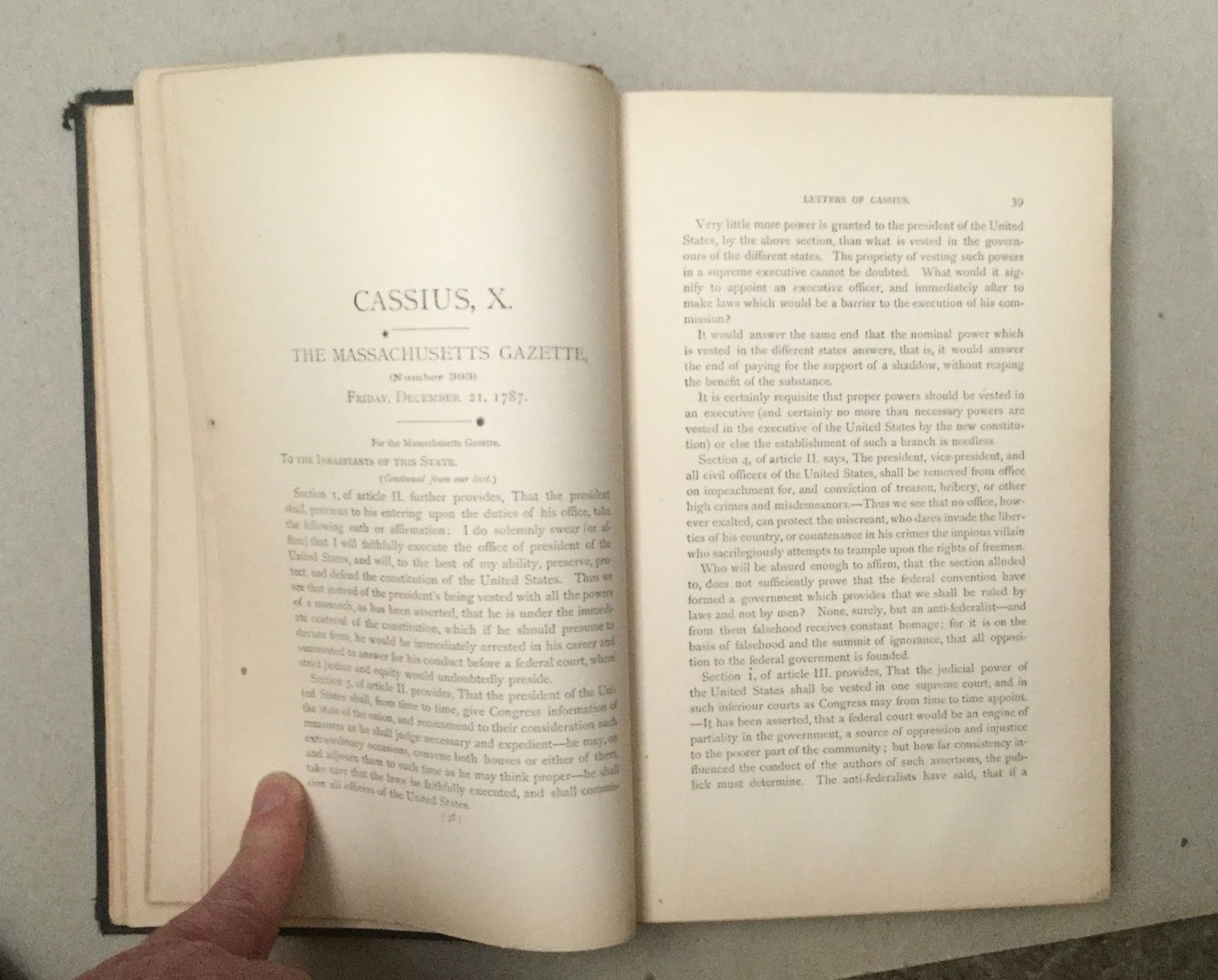


     One of the essays in Ford's book was written by a lawyer and politician who wrote under the pseudonym of Cassius.


CASSIUS

THE MASSACHUSETTS GAZETTE

Friday, December 21, 1787

For the Massachusetts Gazette.

To the Inhabitants of this State.

(Continued from our last)
     Section 1 of article II. further provides, That the president shall, previous to his entering upon the duties of his office, take the following oath or affirmation: I do solemnly swear ( or affirm) That I will faithfully execute the office of president of the United States, and will, to the best of my ability, preserve, protect, and defend the constitution of the United States. Thus we see that instead of the president's being vested with all the powers of a monarch, as has been asserted, that he is under the immediate controul of the constitution, which if he should presume to deviate from, he would be immediately arrested in his career and summoned to answer for his conduct before a federal court, where strict justice and equity would undoubtedly preside....
     Section 4, of article II. says, The president, vice-president, and all civil officers of the United States, shall be removed from office on impeachment for, and conviction of reason, bribery, or other high crimes and misdemeanors.––Thus we see that no office, however exalted, can protect the miscreant, who dares invade the liberties of his country, or countenance in his crimes the impious villain who sacrilegiously attempts to trample upon the rights of freemen.
     Who will be absurd enough to affirm, that the section alluded to, does not sufficiently prove that the federal convention have formed a government which provides that we shall be ruled by laws and not men? No, surely but an anti-federalist (38,39)....
     Cassius, it turns out, was James Sullivan (1744-1808).  Sullivan shared John Hancock's political views, and Hancock rewarded him  by appointing him the Attorney General of Massachusetts in 1790.  Sullivan would later succeed Hancock as Governor.  On a side note, Elbridge Gerry unsuccessfully ran against both Hancock and Sullivan, but finally became governor in 1810.


     The Federalist was first published in 1788 in New York by J. and A. McLean.  It is No. 519 of Everyman's Library series, was first published in the series in 1911, and was reprinted twelve times.  My copy was reprinted in 1917.  The Federalist contains 85 essays, most of which first appeared in the newspapers of New York City.   Alexander Hamilton, John Jay and James Madison all wrote under the pseudonym Publius, and sought to persuade the people of the State of New York to adopt the Constitution.  Alexander Hamilton was the author of Federalist No. LXV.


PUBLIUS

From the New York Packet, Friday, March 7, 1788

THE FEDERALIST. No. LXV (Hamilton) 


To the People of the State of New York:

     The remaining powers which the plan of the convention allots to the Senate, in a distinct capacity, are comprised in their participation with the executive in the appointment to office, and in their judicial character as a court for the trial of impeachments. As in the business of appointments the executive will be the principal agent, the provisions relating to it will most properly be discussed in the examination of that department. We will, therefore, conclude this head with a view of the judicial character fo the Senate.
     A well-constituted court for the trial of impeachments is an object not more to be desired than difficult to be obtained in a government wholly elective. The subjects of its jurisdiction are those offences which proceed from the misconduct of public men, or, in other words, from the abuse or violation of some public trust. They are of a nature which may with peculiar propriety be denominated POLITICAL, as they relate chiefly to injuries done immediately to the society itself. The prosecution of them, for this reason, will seldom fail to agitate the passions of the whole community, and to divide it into parties more or less friendly or inimical to the accused. In many cases it will connect itself with the pre-existing factions , and will enlist all their animosities, partialities, influence, and interest on one side or on the other; and in such cases there will always be the greatest danger that the decision will be regulated more by the comparative strength of parties, than by the real demonstrations of innocence or guilt.
     The delicacy and magnitude of a trust so deeply concerns the political reputation of every man engaged in the administration of public affairs, speak for themselves. The difficulty of placing it rightly, in a government resting entirely on the basis of periodical elections, will be as readily perceived, when it is considered that the most conspicuous characters in it will, from that circumstance, be too often the leaders or the tools of the most cunning or the most numerous faction, and on this account can hardly be expected to possess the requisite neutrality towards those whose conduct may be the subject of scrutiny.
     The convention, it appears, thought the Senate the most fit depositary of this important trust. Those who can best discern the intrinsic difficulty of the thing, will be least hasty in condemning that opinion, and will be most inclined to allow due weight to the arguments which may be supposed to have produced it (332,333)....
     On a side note, which is an end note as well, Alexander Hamilton cites De Lolme in The Federalist  LXX.

Wednesday, August 21, 2019

OMG! Trump Wants to Buy Greenland!


Donald Trump wants to buy Greenland from Denmark, and thus expand the territorial waters of the United States.   And he will name it Great Greenland!  He has even offered to cede Puerto Rico to Denmark!

Such a purchase would indeed expand the territorial waters of the United States because Greenland is melting.  OMG, Oceans Melting Greenland, is a five-year NASA project to measure the effects of ocean water on Greenland's rapidly melting glaciers.  The project is in its fourth year, and in a recent CBS news report, OMG estimates that Greenland is melting six times faster than it was in the 1980s.


Donald Trump, however, wants to purchase Greenland.  On Fox News last night, he stated, "I, and I alone, can stop Greenland from melting!"

The purchase of Greenland, however, requires the approval of the Senate.  But Senate Majority Leader, Mitch McConnell, has already stated he will use the nuclear option in order to ratify the Great Greenland Purchase.

Friday, July 26, 2019

To Impeach or Not to Impeach, That is the Question


To impeach or not to impeach, that is the question
Whether 'tis nobler in the mind to suffer
The slings and arrows of Trump's outrageous fortune,
Or take a vote against a sea of troubles
And by opposing end them.  To die––
To sleep no more....

or

Tomorrow and tomorrow and tomorrow,
Creeps in this petty pace from day to day
Until the recorded votes of the 2020 election are taken;
And all his yesterdays have lighted this fool
The way to dusty defeat. 

 Out, out brief candle!
45 is but a walking shadow, a poor player
Who struts and frets his hour upon the stage,
And then is heard no more. His term is a tale
Told by an idiot, full of sound and fury,
signifying nothing.

Monday, July 22, 2019

On The Future Whitening of the Statue of Liberty: God Forbid!

Let's call a spade a spade:  Donald Trump's slogan, "Make America Great Again," had nothing whatsoever to do with the phrase, "Make America White Again."  And the use of the word "spade" here has nothing whatsoever to do with black people, or even brown-skinned people for that matter.  To think otherwise would be unpatriotic and blasphemous.  It would be Fake News.

Likewise,  Donald Trump's desire to cover the Statue of Liberty with a coat of white paint has nothing whatsoever to do with his immigration policy.  It is Fake News that he only wants white people to emigrate to the United States.   It is simply a matter of Location. Location. Location.  White people come from Europe.  Therefore, Liberty Island is the best place for them to enter the United States.  Black people, and brown-skinned people for that matter, come from South America and Central America.  Therefore, the Border Wall is the best place for those kind of people to try to enter the United States.

If black people, and brown-skinned people for that matter, can safely scale the fifty-foot Border Wall without getting shredded to bits by the barbed wire on top of it, then they can apply for one of the fifty asylum slots available for southern border immigrants this year.  Next year  it will be twenty-five!  And that is not Fake News!

Now that the 2020 election is over, we can honestly call "a spade a spade,"  so to speak.  And we will!  So from here on in,  countries in South America and Central America shall be called what they are: shit-hole countries.  Beginning this Sunday, black people, and brown-skinned people for that matter, will be rounded up by ICE and deported back to where they came from: shit-hole countries.  Then and only then can we "Keep America Great White Again."

And as our ever-faithful evangelicals say, "God Bless America!"


Monday, June 10, 2019

Mueller, My Fellow Americans, and Me:
Finding Truth and Justice the American Way


Yep.  That's me lounging at the beach reading a book––not just any book: I was reading The Mueller Report.  I wanted to find and learn the truth myself.

The Attorney General of the United States, William Barr, had read the Mueller Report and stated:
...the evidence developed during the Special Counsel's investigation is not sufficient to establish that the President committed an obstruction-of-justice offense.  Our determination was made without regard to, and is not based on, the constitutional considerations that surround the indictment and criminal prosecution of a sitting President.


Yet,  Newsweek recently reported that "more than 1,000 bipartisan former prosecutors have now signed their names on a petition maintaining that, if Trump weren't President of the United States, he would have been indicted on multiple charges for obstruction of justice."

Can over 1,000 former federal prosecutors be wrong? Was the Attorney General of the United States attempting to hide the truth and therefore protect the President?  Did the President of the United States of America actually attempt to obstruct justice?


May 29, 2019: Special Counsel Robert S. Mueller III  
The Report Speaks For Itself

In his report and again in his statement on the 29th of May, 2019, Robert Mueller stated that, according to the opinion of the Office of Legal Counsel of the Justice Department, a sitting President cannot be indicted or prosecuted.   Mueller went further in his report and added:
...if we had confidence after a thorough investigation of the facts that the President clearly did not commit obstruction of justice we would so state.  Based on the facts and the applicable legal standards, however, we are unable to reach that judgment.  The evidence we obtained about the President's actions and intent presents difficult issues that prevent us from conclusively determining that no criminal conduct occurred.  Accordingly, while this report does not conclude that the President committed a crime, it also does not exonerate him.
After reiterating in his May 29 statement why he couldn't indict or prosecute a sitting President, Mueller suggested an alternative action, "The Constitution requires a process other than the criminal justice system to formally accuse a sitting President of wrongdoing."  Here, he is indirectly referring to the constitutional process of impeaching a President.  In essence, The Mueller Report itself is a roadmap for impeachment––if Congress decides to go that route.

I will verify that The Mueller Report speaks for itself.  After reading the report, I agree with more than 1,000 bipartisan former federal prosecutors that Donald Trump would have been indicted on multiple charges of obstruction of justice if he was not President of the United States.  No person, not even the President of the United States, is above the law.

Believe it or not, there are some Republicans who still believe that the rule of law is the American way of finding truth and justice.  One such group, aptly named Republicans For The Rule of Law wants their fellow Americans to read The Mueller Report, either in its entirety, or, as a minimum, to read the executive summaries of the report.

Read the Executive Summaries of the Mueller Report

 Recently, the Republicans For The Rule of Law  announced that it will be hand delivering pre-highlighted copies of The Mueller Report to Republican Congressmen for them to read.   But will the Congressmen read it? Will they do anything about it? Will you, my fellow Americans read it?  Will you do anything about it?

Beginning today, the House Judiciary Committee is holding hearings on the findings of the Mueller Investigation.  The purpose of the hearings is to inform the Americans who have not read the report.  The Mueller Report speaks for itself.  All you have to do is listen.


Monday, May 6, 2019

The Constitutional Crisis Over the Mueller Report


This is my first post of this year.  And for good reason.  I could not fathom that 63 million Americans voted for Donald Trump in the 2016 election.  Or that almost 90 percent of the Republican Party still backs Trump.  I thought it best to wait for the Mueller Investigation to be completed before posting to this political blog again.

In the meantime, life went on as usual.  The Press kept Democrats informed of how the Mueller Investigation was going.  Meanwhile, Fox News kept Republicans informed of well Trump was running the country.  Trump himself was still upset that Attorney General Jeff Sessions had recused himself, and finally, he fired Sessions in November 2018, appointing Matthew Whittaker as the Acting Attorney General.  Whittaker's sole qualifications for the job was that he publicly acclaimed that Trump did not either collude with the Russians or obstruct justice.

The Trump Administration, however, was already working on promoting someone else for Attorney General:  William Barr, who had served as Attorney General under Bush 43, and aided him during the Iran Contra Affair.  Barr's primary qualifications for becoming Trump's Attorney General is that he firmly believed that a President could not obstruct justice.  In fact, he advertised for the job circulating a nineteen-page memo around the Justice Department arguing that Trump could not be charged with obstruction in the performance of his executive actions.   The Republican-controlled Senate confirmed Barr as the Attorney General on Feb 14, 2019.  The stage was now set.  Democrats and Republicans were still awaiting the completion of the Mueller Investigation.

On March 22, 2019, Attorney General Barr announced that Robert Mueller had submitted his full report on the investigation to the Justice Department.  And on March 24th, Barr released a four-page summary of the principal conclusions of Mueller's findings.  Barr reported that Mueller's investigation "did not find that the Trump campaign or anyone associated with it conspired or coordinated with Russia in its efforts to influence the 2016 U.S. presidential election." Barr, however, as we found out later, muddied the waters with respect to announcing the results of the Obstruction of Justice investigation.  Mueller, for reasons not stated by Barr, did not reach any legal conclusions as to whether any of Trump's conduct described in the report constituted a crime.  Mueller simply listed Trump's actions in ten situations where obstruction may have occurred.  And Mueller said that "while this report does not conclude that the President committed a crime, it also does not exonerate him."  Since Mueller did not come to a legal conclusion, Barr felt it was his duty to make the legal determination.  In his summary Barr wrote:
Deputy Attorney General Rod Rosenstein and I have concluded that the evidence developed during the Special Counsel's investigation is not sufficient to establish that the President committed an obstruction-of-justice offense.  Our determination was made without regard to, and is not based on, the constitutional considerations that surround the indictment and criminal prosecution of a sitting President.
Barr went on to reason that since the President was not involved in a crime related to Russian election interference, that Trump's actions, "many of which took place in public view," could not be construed as obstruction.  Republicans were delirious.  Trump was ecstatic!  No collusion! No obstruction!  Soon, Trump and the Republicans turned vindictive, calling for investigations of "the treasonous politicians and government officials who initiated the investigation."

Barr said he needed time to get the necessary portions of Mueller's report redacted before he could release the Mueller Report to Congress and to the public.  For three weeks all the public heard was "No collusion. No obstruction.  Collusion Delusion."  When the redacted Mueller Report was finally released on April 18th,  Democratic Congressional leaders loudly complained that Barr had misrepresented the results of Mueller's investigation.

The House Committees, now controlled by the Democrats, were determined to consider the evidence of the Mueller Report and continue their investigations of Trump and his administration. And they requested the unredacted version of the report. But as far as Trump and the Republicans were concerned, the investigation was over.  Barr had ruled in favor of the President.  Game over.

All hell broke loose the night of April 30th, 2019.  The Washington Post and then the New York Times leaked a March 27, 2019 letter that Robert Mueller had written William Barr.  Mueller memorialized the letter by submitting it through official channels.  In his March 27 letter,  Mueller mentioned a March 25th letter he had sent to Barr which contained redacted introductions and summaries that Mueller wanted Barr to release to Congress and to the public.  Barr refused to release the introductions and summaries.  Mueller further complained that Barr's four-page summary of March 24th "did not fully capture the context, nature, and substance" of Mueller's work."  Mueller warned that Barr's summary and the subsequent confusion over the results of the Mueller Investigation "threatens to undermine a central purpose for which the Department appointed a Special Counsel: to  assure full public confidence in the outcome of the investigations."

Attorney General Barr appeared before the Senate Judiciary Committee on May 1st.  He was assailed by the Democratic members of the Committee, but supported by the Republican members of the Committee, some of whom called for reopening investigations of Hillary Clinton's Email Server, as well as calling for an investigation of how the Russian investigation was initiated in the first place.

Attorney General Barr was scheduled to appear before the House Judiciary Committee the next day, May 2nd, but did not appear.  Barr also ignored a House subpoena to provide Congress with an unredacted version of the Mueller Report that was due on Monday May 6th.  The House Judiciary Committee was scheduled to vote on Wednesday, May 8th on whether to hold Barr, the Attorney General of the United States, in Contempt of Congress.

In the meantime, the Trump Administration cited executive privilege to forbid current and former Trump Administration officials from testifying in Congressional Oversight Investigations.  Moreover, the Trump Administration has refused to honor all subpoenas for records requested for Congressional Oversight Investigations, in effect stonewalling Congress's Constitutional Oversight Responsibilities.

And that is the Constitutional Crisis.  The Trump Administration's decision to ignore Congressional subpoenas effectively thwarts the constitutional responsibility of the Legislative Branch (Congress) to provide oversight over the actions of the Executive Branch.  Being charged with Contempt of Congress currently has no teeth. Moreover, the Trump Administration figures it will be a slow, slow process, probably all the way up to the 2020 election, if Congress seeks redress through the courts.  If a Trump Administration official is charged and convicted of Contempt of Court, what is stopping Trump from pardoning the official?

And that is how things stand as of the week of May 6, 2019.  The House Judiciary Committee is working behind the scenes to set a date for Robert Mueller to testify before the Committee possibly as soon as the 15th of May.  There are several issues that only Mueller can resolve.  Did Mueller agree with Barr's decision to exonerate Trump? Did Mueller decline to charge Trump with obstruction because of the Justice Department's policy that a sitting President cannot be indicted?  Did Mueller provide the results of the obstruction investigations as a road map to impeachment? Why didn't Mueller issue a subpoena to force Trump to testify before the Grand Jury?  Did Barr curtail the investigation in any way?

Getting Mueller to testify should upset the judicial apple cart of the Trump Administration.  Once Mueller testifies, public outcry should negate Barr's Summary of misrepresenting Mueller's findings, and Trump will once again be in the hot seat.  But voting him out of office will be a far better alternative than trying to impeach him.  The Republican Party has stooped so low that they might always be "for Trump" and never again be "for Country."

It is at this crossroad in American history that we should look back forty-five years to the Watergate break-in and the Watergate Tapes.  In 1974, the Watergate Grand Jury identified President Nixon as an unindicted co-conspirator of the Watergate break-in.  Special Prosecutor Jaworski obtained a subpoena from the grand jury ordering President Nixon to turn over the tapes relating to forty-two Presidential conversations.  President Nixon claimed executive privilege and the case was eventually expedited all the way to the Supreme Court.  One Supreme Court Justice, William Rehnquist, recused himself because he had previously served as Assistant Attorney General in the Nixon Administration.  The other eight Supreme Court Justices ruled unanimously that executive privilege was not absolute and that the needs of a judicial court overrode that privilege.  Jaworski had proved that the tapes likely contained evidence of wrongdoing on the part of Nixon: the Nixon-Haldeman tape, the smoking gun that led to Nixon's resignation.   Will the Supreme Court have to step in again?  And will the two Trump appointees recuse themselves?


Friday, December 21, 2018

Can and Will the 116th Congress Override a Presidential Veto?


     Donald Trump will not sign a CR or a budget bill unless it contains billions of dollars to build his wall.  And the government is about to be shutdown.  House Speaker Ryan didn't have the gumption to put the CR up for a vote.  Instead he sent a bill to the Senate which contains the billions of dollars Trump demands for his wall.  The Senate will not pass Ryan's bill.  And the government will shutdown.
     Incoming House Speaker Pelosi can't wait until Jan 3rd to retake the gavel!  Once the 116th Congress is in session, Pelosi, Schumer and McConnell might negotiate and reach a settlement, but I doubt that it will contain the billions of dollars Trump demands to build his wall.  Sooner or later, McConnell will have to stand up to Trump.  And I believe the majority of Republicans in the Senate will follow his lead. 
     In the House, I believe House Speaker Pelosi will be able to pass a CR or budget bill.  And when Trump vetoes the bill, I believe Pelosi will be able to convince 53 of the remaining 198 Republicans to override Trump's veto.
Schumer and McConnell will have the necessary votes to override Trump's veto as well. Wishful thinking? Maybe.... Let governance begin!